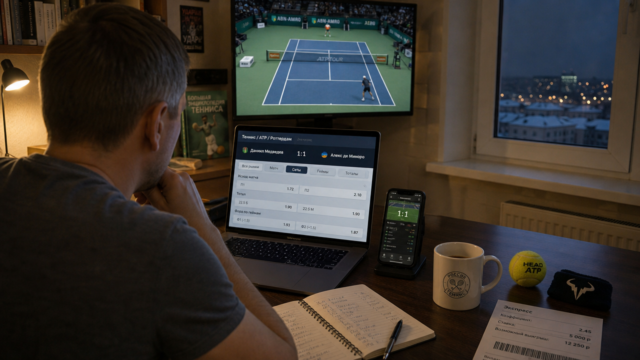

Tennis betting benefits from a year-round calendar, individual matchups, and fast live action. Pre-match analysis starts with player form and surface data, while live betting can offer more information as the match develops. Major tournaments usually have deeper analytics and tighter lines; smaller events may offer more value when coverage is weaker and line errors are more likely.
Cash Flows in Tennis Betting Are the First Filter
A betting-volume tracker can show activity across men’s and women’s tours and major tournaments. Large financial shifts may reveal injury news or informed market activity before bookmakers adjust their prices. These signals are indicators, not guarantees.
Compare the direction of price movement with the share of public tickets. If most tickets support one player but the price moves against that player, the cash flow may be pointing elsewhere. Check the line over the previous 24 hours, then look for a surface-specific reason before placing a bet. Volume without supporting match information is noise.
Signal Groups Do Not Replace Surface Data
Do not import pricing habits from signal groups into professional tennis markets. A note that Cerundolo and Davidovich Fokina have equal chances points to a close match, with at least one long set, rather than an automatic moneyline position. Signal groups may help identify matches for further review, but they should not replace independent analysis.
The same rule applies to other picks. Etcheverri is favored over Jacque because of his greater experience, stronger serve, and higher overall level, although Jacque can remain competitive through aggressive play. Etcheverri’s edge is clearer if he limits unforced errors.
Surface Stats: Hold Percentage and Break Rate Do the Work
Ranking context tells less than hold and break numbers on the relevant surface. Compare how often each player holds serve, creates break chances, and converts them against opponents of a similar level. A strong serve may matter more on hard courts, while return quality and extended rallies can carry more weight in slower conditions.
Use these figures with tournament context and recent form. Major events often provide more reliable data, whereas smaller tournaments require greater caution because analysis may be less complete and market errors may be harder to assess.
How to Correctly Place a Bet on Tennis
Start with the market that has the clearest analytical edge, not the most familiar option. Pre-match betting should be based on player form, surface performance, matchup dynamics, and price. Live betting adds information from the match itself, but fast price changes can also increase risk.
Keep tennis staking separate from other sports, avoid combining unrelated selections, and treat every signal as an indicator rather than a guarantee. A disciplined approach means comparing the available price with your estimated probability and passing when the market no longer offers value.