
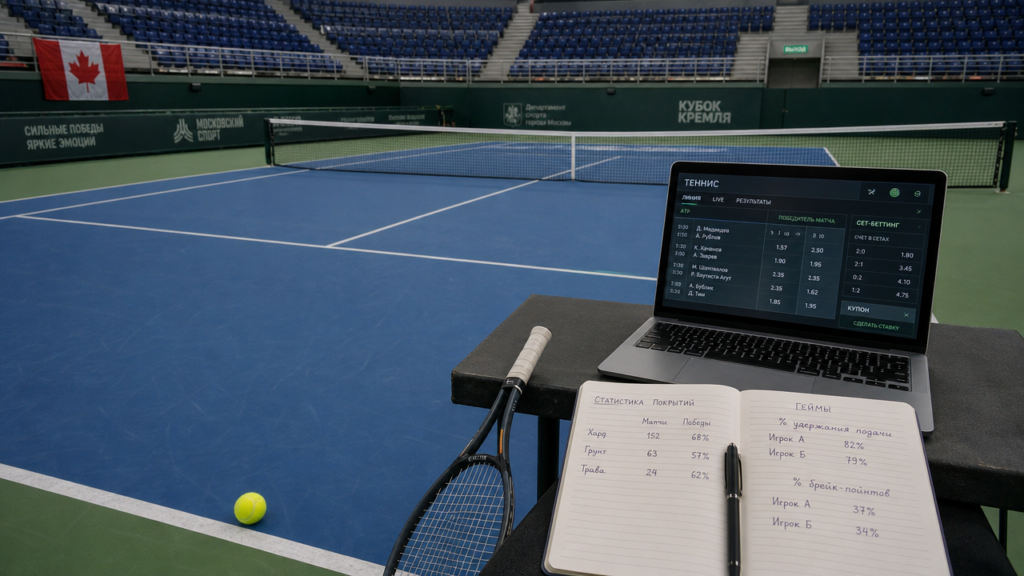
Tennis offers two outcomes and no draw, so the moneyline moves more sharply than football’s 1X2 market. Surface data, player form and endurance are more useful than a ranking alone when deciding what tennis bets to place. Common markets include the moneyline, game handicap, total games, set betting and tiebreak totals.
Surface Stats Before the Ranking
Fast grass produces a low bounce and short points, which rewards powerful servers and flat hitters. Slow clay creates longer rallies and gives returners and topspin players more time to build points. The surface amplifies a player’s style, so ignoring it can make rating-based betting unreliable. Before backing a player on any court, check the hold and break percentages for that surface rather than relying on the official ranking alone.
| Player profile | Best conditions | Key betting angle |
|---|---|---|
| Powerful server | Fast grass or indoor hard | Consider tiebreak and high total-games markets |
| Flat hitter | Fast courts with a low bounce | Compare serve and return numbers before choosing a handicap |
| Returner or topspin player | Slow clay | Look at break rates and longer-rally performance |
| Balanced player | Surface-dependent | Use recent form, match history and fitness data together |
Daily Tour Picks: What Tennis Bets to Choose
A daily prediction should begin with player form, match history, injuries and any other availability concerns. Those factors matter alongside bookmaker odds, particularly when a player is priced as a clear favorite. A strong recent record is not enough if the opponent’s style suits the court better or if the match is likely to produce long rallies.
For men’s and women’s matches, compare the moneyline with game and set handicaps. A favorite may still be vulnerable to a close set, while an underdog with a strong return game can offer more interest on a set handicap or total-games line. Live betting also has a large role in tennis because momentum can change quickly and a match can contain several comeback opportunities.
Major-Tournament Previews: Set Betting for Canadian Players
Major-tournament previews for Canadian players should start with the format, surface and recent workload. Best-of-five matches on the men’s tour allow a player to lose one set and still win, while women’s matches are generally shorter. That difference affects set handicaps, total sets and total games.
A player with a reliable serve and strong tiebreak record can be considered for a positive set handicap against a higher-ranked opponent, especially on a fast court. On clay, break-point numbers and return depth deserve more attention because longer rallies create more chances to break. If a Canadian player is priced as a slight underdog, the total-games or positive set-handicap market may be more suitable than the moneyline, provided the surface and recent form support the position.
Set Betting Tips: Tiebreak Rate and Total Games
Tiebreak markets work best when both players hold serve at a high rate. Fast courts favor powerful servers and flat hitters because the low bounce gives opponents less time to react. On clay, increased return pressure makes breaks more common and can reduce the appeal of a tiebreak market.
Use tiebreak props on fast courts when both players rely on the first serve. On slower courts, total games can be more useful when returners extend rallies without creating a one-sided match. For any line, compare recent hold and break percentages with the player’s longer-term record on the same surface.
Avoid novelty table-tennis products when the goal is professional tennis analysis. These events do not involve professional tour players and do not provide the same surface-based hold or break data. Tour-level statistics offer a more relevant basis for tennis betting.
A Disciplined Betting Approach
Choose a market only after checking surface, form, match history, fitness and the available odds. Keep stakes proportional to the uncertainty of the matchup, and reassess the position if the line changes sharply. A moneyline is not automatically safer than a game or set handicap: the best choice depends on the surface, format and the way both players create and save break points.