
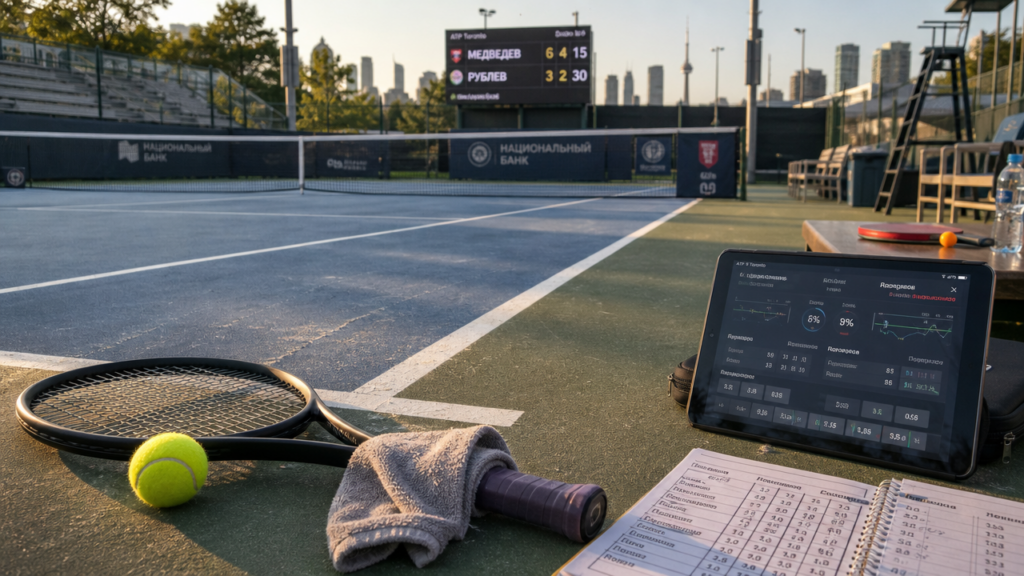
For an outdoor hard-court tennis match in Toronto, compare the moneyline, game total, and game handicap. Serve and return numbers can support a handicap, while court surface, first-serve percentage, second-serve points won, stamina, and double faults should shape the overall assessment.
Surface stats and hold numbers
A player’s hold rate shows how often they protect their service game. Break rate, first-serve accuracy, points won on the second serve, and break points saved help explain whether a handicap or total has support. Fast courts generally produce fewer breaks, while clay tends to create more break opportunities.
| Metric | Why it matters |
|---|---|
| Hold rate | Indicates how often a player keeps serve |
| First-serve percentage | Shows how reliably a player starts points on serve |
| Second-serve points won | Helps assess vulnerability after a missed first serve |
| Break rate | Measures success against an opponent’s serve |
| Double faults | Can create extra break opportunities |
| Tiebreak record | Matters when sets remain close |
A game total adds every game played in the match. For example, over 10.5 games requires at least 11 games in a set, while under 10.5 requires 10 or fewer. A set can end at 6-4, 7-5, or 7-6 after a tiebreak. Totals above 12.5 usually need a tiebreak or a very close set.
Set markets and major tournaments
To make money on tennis betting, avoid pairing the same stake on the moneyline and the over without checking the players’ hold and return profiles. In best-of-three tennis, over 2.5 sets means the match reaches a third set; under 2.5 sets means one player wins in straight sets.
Set betting can also involve a player winning at least one set or taking a set handicap. These markets should be compared with surface trends, stamina, recent serve performance, and the opponent’s ability to create breaks. A player with a strong return profile may offer more appeal in a game handicap than in the moneyline, but the match format and price still matter.
Table tennis alternative and bankroll placement
Best bets on table tennis require a different approach from tennis handicapping. Matches are played indoors and commonly use best-of-three, best-of-five, or best-of-seven formats. Players generally need 11 points to win a game and must lead by two. The sport is suited to live betting because matches and games move quickly, while the server’s advantage is less pronounced than in tennis.
To place a bet on tennis, select the match, compare the available market prices, and choose the clearest statistical angle. A flat-staking approach can use 1 to 5 percent of the bankroll, with the same percentage applied consistently. Record the opening odds, closing odds, and the condition that would cancel the bet before play begins.
Track totals, handicaps, set markets, and exact scores separately. This makes it easier to see which markets fit your analysis and prevents one match from taking too large a share of the bankroll.